PRE-LITIGATION DRAFTING

‘Pre-litigation Drafting’ assists legal practitioners and those who are required to write documents such as legal opinions
and letters of demand in two ways:

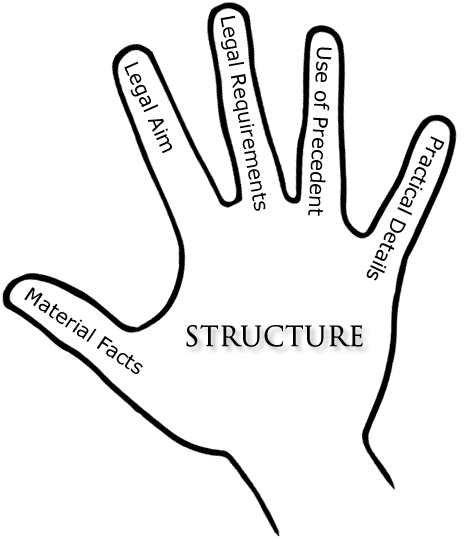
• It provides writers with a five-finger exercise for thinking and planning before starting to write;
• Using practical legal examples, the book explains how to write in plain language.

The five-finger exercise before planning to write a legal document

The index finger points to the legal aim that is the legal remedy on which the client’s claim is based.
The middle finger represents the essential legal requirements that are the elements of the legal remedy.
The thumb represents a selection of only those facts that are material because they establish the factual existence of the essential elements.
The ring finger represents the possibility of using a precedent as an example of how to draft the claim.
The little finger represents practical ramifications of pursuing the legal solution and the details that are needed to make it happen.
The palm provides the structure that orders the written claim coherently and cohesively in numbered paragraphs.
 
These aspects of the cognitive process are not discrete items of thought to deal with in sequence one after the other. They are facets of thought that interweave with one another throughout the thinking and planning process.

How to write in plain legal language

There are several reasons why it is imperative for legal practitioners to use plain language. The book, ‘Pre-litigation Drafting’, deals with most of them, including this legislative imperative:

Section 64(1) of South Africa’s National Credit Act 34 of 2005 provides that:

the producer of a document that is required to be delivered to a consumer in terms of this Act must provide that document -

(a) in the prescribed form, if any, for that document; or
(b) in plain language, if no form has been prescribed for that document.

In his book on plain language, The Complete Plain Words 3 ed (Penguin 1986), Sir Ernest Gowers provides this simple rule:

Be short, be simple, be human

Based on this simple rule, and using practical legal examples, ‘Pre-litigation Drafting’, shows its readers how to write in plainly to address the needs of a target audience.